|
|
Dahlia Classification and Formation |
![]() |
|
| ● About Dahlias |
| ● History |
| ● Species |
| ● Classification |
| ● Family Tree |
| ● Cultivation |
| ● Pests&Diseases |
| ● Naming Rules |
| ● Timeline |
| ● Home |
![]() NORTHWEST COSMOS Group 1--Single-flowered Dahlias Single dahlias have blooms with a single outer ring of florets, which may overlap, the centre forming a disc. ▲Top |
|
![]() STILLWATER PEARL Group 2--Anemone-flowered Dahlias Anemone-flowered dahlias have blooms with one or more outer rings of generally flattened ray florets surrounding a dense group of tubular florets, and showing no disc. ▲Top |
|
![]() TEESBROOKE REDEYE Group 3--Collerette Dahlias Collerette dahlias have blooms with a single outer ring of generally flat ray florets, which must overlap, with a ring of small florets (The Collar) the centre forming a disc. ▲Top |
|
|
Group 4 – Waterlily Dahlias Waterlily dahlias have fully double blooms characterised by broad ray florets that are slightly involute along their length (longitudinal axis) giving a saucer shaped appearance to the bloom. The depth should be not more than one third of the diameter of the bloom. ▲Top |
|
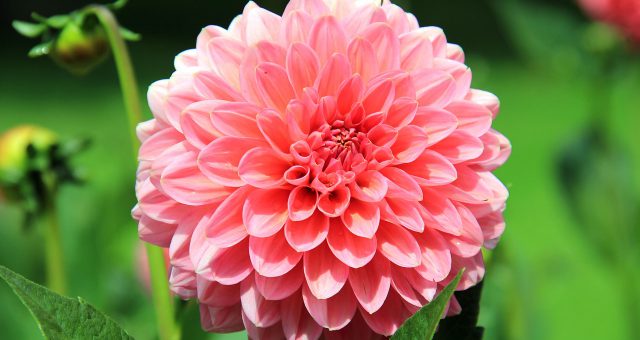
![]() ELMA E GATESHEAD FESTIVAL Group 5-- Formal Decorative Dahlias Decorative dahlias have fully double blooms showing no disc. The ray florets are generally broad and flat and may be involute for no more than 75% of their length (longitudinal axis) or slightly twisted, and usually bluntly pointed. ▲Top |
|
|
Group 6--Ball Dahlias Ball dahlias have fully double blooms, ball shaped or slightly flattened. The ray florets rounded at the tips, with margins spirally arranged and involute for at least 75% of the length of the florets. ▲Top |
|
|
Group 7--Pompon Dahlias Pompon dahlias have fully double spherical blooms of miniature size, with florets largely involute along their length (longitudinal axis). ▲Top |
|
|
Group 8--Cactus Dahlias Cactus dahlias have fully double blooms, the ray florets are usually pointed, the majority narrow and revolute for 65% or more of their length (longitudinal axis) and either straight or incurving. ▲Top |
|
|
Group 9--Semi-Cactus Dahlias Semi-Cactus dahlias have fully double blooms; the ray florets are usually pointed and revolute for more than 25% and less than 65% of their length and broad at the base and either straight or incurving. ▲Top |
|
|
Group 10 - Miscellaneous Dahlias Any dahlias which do not fall into type 1 – 9 inclusive and type 11, 12,13 & 14 e.g. Thistle Dahlias, etc. This group includes species dahlias. ▲Top |
|
|
Group 11- Fimbriated Dahlias Fimbriated dahlias have blooms where the tips of the ray florets should be evenly split or notched into two or more divisions, uniformly throughout the bloom to create a fringed overall effect. The petals may be flat, involute, revolute, straight, incurving or twisted ▲Top |
|
|
Group 12 – Star Dahlias Star dahlias have blooms with a single outer ring of florets surrounding the disc. Ray florets are uniformly either involute or revolute. ▲Top |
|
|
Group 13 – Double Orchid Dahlias Double Orchid dahlias have fully double blooms showing no disc and have triangular centres. Ray florets are narrowly lance shaped and either involute or revolute. ▲Top |
|
|
Group 14 - Paeony Dahlias Paeony dahlias have multiple outer rings of ray florets surrounding a disc, ray florets are flat or slightly involute at base and are flat or are to some extent revolute. ▲Top |
|
COLOUR CLASSIFICATIONFor the purpose of Colour Classification, all colours, shades, tints hues and combinations thereof found in the cultivated forms of the dahlia have been grouped in the following twelve divisions. The predominant colour or colours determine colour Classification which appear on the face of the ray florets and in such classification the colour of the reverse of the ray florets is not generally taken into consideration. An exception is made in the case of certain orchid-flowered, pompon or ball dahlias. Cultivars classified in colour must not be exhibited in any other colour class other than that indicated in the alphabetical list of cultivars. Cultivars not included in this list may be shown in groups appropriate to their colour. In the case of blended, bi-colours or variegated cultivars the first colour indicated is the dominant colour, and such cultivars may be exhibited in classes for blooms of their dominant colour except where separate classes for blended and/or bicoloured and/or variegated cultivars are included in the show schedule. ▲Top COLOUR DIVISION OF DAHLIASThe numbers in parentheses refer to comparative colour numbers as listed in the Royal Horticultural Society Colour Chart. WHITE.----(155, 157, 158, 159.) YELLOW. ----(2, 3, 4, 5, 6, 7, 8, 9, 10, 11, 12, 13, 14, 15, 16, 17, 18, 19.) ORANGE.----(21, 23, 24, 25, 28.) BRONZE. ----(20, 22, 26, 161, 162, 163, 164, 165, 166, 167, 168, 169, 170, 171, 172, 173, 174.) FLAME.----(30, 31, 32, 33.) RED or DARK RED.----(34, 40, 41, 42, 43, 44, 45, 46, 47, 50, 52, 53, 183, 184, 185.) PINK.----- (27, 29, 36, 37, 38, 49, 51, 54, 55, 56, 62.) LILAC, LAVENDER or MAUVE.----(65, 68, 69, 73, 75, 76, 85, 91, 92.) PURPLE, WINES or VIOLETS.----(57, 58, 59, 60, 61, 63, 64, 66, 67, 70, 71, 72, 74, 77, 78, 79 ,80, 81, 82, 83, 84, 86, 87, 88.) BLENDS.---- Cultivars in which two or more colours are intermingled and gradually merge into each other and are not provided for above. BICOLOURED and VARIEGATED.---- Cultivars, in which the ground colour is tipped, striped or splashed with another colour. |
|
▲Top |